
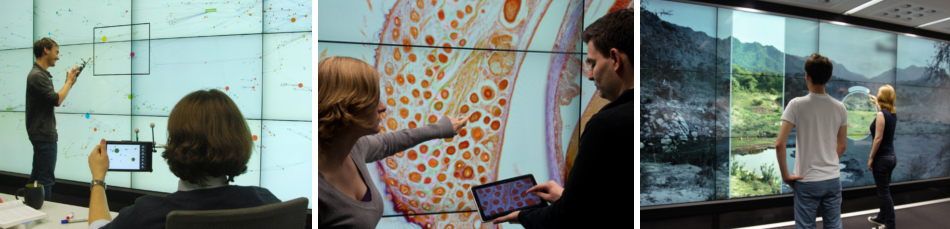
Working with complex data, reaching decisions based on multiple information sources and sensemaking activities are increasingly executed by collaborative teams, which often consist of multiple experts. Examples are tumor board reviews, where doctors from different disciplines discuss patient data for optimal treatment planning, control rooms, where various incoming information streams are monitored and analyzed, or strategy and idea engineering meetings, where people analyze notes, sketches and other media to cooperatively generate ideas and objectives. In all these and other scenarios, people are co-located, collaborate with each other and make increasing use of digital support. Where previously whiteboards or single displays have been used, there is a growing number of setups with interactive large wall displays being the center of attention and team discussion. In addition, mobile personal devices, such as laptops, tablets or smartphones, and horizontal tabletop displays are being used in what has been termed a Multi-Display Environment (MDE).
The project CollabWall investigates these collaborative scenarios to develop a systematic and foundational understanding of collaborative workflows in MDEs. It will inquire how collaborative work is actually accomplished in such environments, how the transition between individual and group work happens, which roles users take over in MDEs, how, where and when awareness information shall be displayed and how the space in front of and on the wall display is being used. As a basis, we will develop a design space of influencing dimensions for MDE collaboration. To better understand interaction, movement, and proxemic patterns, we will develop a novel MDE analysis toolkit comprising complex visualization views, which allows for a semi-automated analysis of recorded behavior. By conducting several empirical studies, we will then identify behavior patterns of collaborating users, focusing our research on the usage of space, awareness aspects and dynamically changing roles. As a result, we will carefully develop design guidelines, which facilitate the design of future collaborative user interfaces in MDE.
Associated Publications
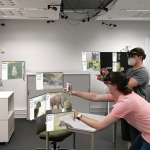
@inproceedings{luo2022arsensemaking,
author = {Weizhou Luo and Anke Lehmann and Hjalmar Widengren and Raimund Dachselt},
title = {Where Should We Put It? Layout and Placement Strategies of Documents in Augmented Reality for Collaborative Sensemaking},
booktitle = {Proceedings of the 2022 CHI Conference on Human Factors in Computing Systems},
series = {CHI '22},
year = {2022},
month = {4},
location = {New Orleans, LA, USA},
numpages = {16},
doi = {10.1145/3491102.3501946},
publisher = {ACM},
address = {New York, NY, USA},
keywords = {spatiality, spatial layout, content organization, sensemaking, affordance, qualitative user study, Augmented Reality, Mixed Reality, collaborative sensemaking}
}List of additional material
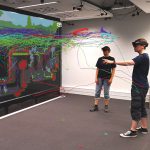
@inproceedings{fixme,
author = {Wolfgang B\"{u}schel and Anke Lehmann and Raimund Dachselt},
title = {MIRIA: A Mixed Reality Toolkit for the In-Situ Visualization and Analysis of Spatio-Temporal Interaction Data},
booktitle = {Proceedings of the 2021 CHI Conference on Human Factors in Computing Systems},
series = {CHI '21},
year = {2021},
month = {5},
isbn = {978-1-4503-8096-6/21/05},
location = {Yokohama, Japan},
numpages = {15},
doi = {10.1145/3411764.3445651},
publisher = {ACM},
address = {New York, NY, USA},
keywords = {interaction analysis, immersive analytics, in-situ analysis, in-situ visualization, augmented reality, human-computer interaction, visualization}
}List of additional material
@inproceedings{fixme,
author = {Barrett Ens and Benjamin Bach and Maxime Cordeil and Ulrich Engelke and Marcos Serrano and Wesley Willett and Arnaud Prouzeau and Christoph Anthes and Wolfgang B\"{u}schel and Cody Dunne and Tim Dwyer and Jens Grubert and Jason H. Haga and Nurit Kirshenbaum and Dylan Kobayashi and Tica Lin and Monsurat Olaosebikan and Fabian Pointecker and David Saffo and Nazmus Saquib and Dieter Schmalstieg and Danielle Albers Szafir and Matthew Whitlock and Yalong Yang},
title = {Grand Challenges in Immersive Analytics},
booktitle = {Proceedings of the 2021 CHI Conference on Human Factors in Computing Systems},
series = {CHI '21},
year = {2021},
month = {05},
isbn = {978-1-4503-8096-6/21/05},
location = {Yokohama, Japan},
numpages = {17},
doi = {10.1145/3411764.3446866},
publisher = {ACM},
address = {New York, NY, USA}
}List of additional material
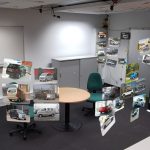
@inproceedings{luo2021investigating,
author = {Weizhou Luo and Anke Lehmann and Yushan Yang and Raimund Dachselt},
title = {Investigating Document Layout and Placement Strategies for Collaborative Sensemaking in Augmented Reality},
booktitle = {Proceedings of the 2021 CHI Conference Extended Abstracts on Human Factors in Computing Systems},
series = {CHI EA '21},
year = {2021},
month = {5},
isbn = {78-1-4503-8095-9/21/05},
location = {Yokohama, Japan},
numpages = {7},
doi = {10.1145/3411763.3451588},
publisher = {ACM},
address = {New York, NY, USA},
keywords = {user study, spatiality, sensemaking, content organization, grouping, physical environment}
}List of additional material
Pre-recorded talk, Full video, 30-seconds preview video, Poster
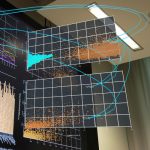
@article{Reipschlaeger2021,
author = {Patrick Reipschl\"{a}ger and Tamara Flemisch and Raimund Dachselt},
title = {Personal Augmented Reality for Information Visualization on Large Interactive Displays},
journal = {IEEE Transactions on Visualization and Computer Graphics},
volume = {27},
issue = {2},
year = {2021},
month = {2},
location = {Salt Lake City, UT, USA},
pages = {1182--1192},
numpages = {11},
doi = {10.1109/TVCG.2020.3030460},
publisher = {IEEE},
keywords = {Augmented Reality, Information Visualization, InfoVis, Large Displays, Immersive Analytics, Physical Navigation, Multiple Coordinated Views}
}List of additional material
, Video
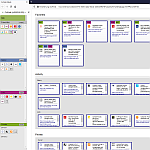
@inproceedings{Fuhrmann2020,
author = {Robert Fuhrmann and Anke Lehmann and Annett Mitschick and Ricardo Langner and Raimund Dachselt},
title = {CoFind: A Browser Plugin for Investigating Co-located Collaborative Web Search},
booktitle = {Mensch und Computer 2020 - Tagungsband},
year = {2020},
month = {9},
pages = {425–429},
numpages = {5},
doi = {10.1145/3404983.3410012},
publisher = {ACM},
address = {New York},
keywords = {collaborative information seeking, awareness, web search}
}List of additional material
@inproceedings{fixme,
author = {Wolfgang B\"{u}schel and Georg Eckert and Raimund Dachselt},
title = {Challenges in Collaborative Immersive Visualization},
booktitle = {CHI 2020 Workshop on Immersive Analytics: Envisioning Future Productivity for Immersive Analytics},
series = {CHI '20},
year = {2020},
month = {4},
location = {Honolulu, Hawaii, USA},
pages = {1--6},
numpages = {6}
}List of additional material
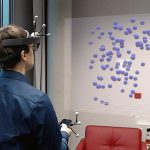
@inproceedings{bueschel2019,
author = {Wolfgang B\"{u}schel and Annett Mitschick and Thomas Meyer and Raimund Dachselt},
title = {Investigating Smartphone-based Pan and Zoom in 3D Data Spaces in Augmented Reality},
booktitle = {Proceedings of the 21st International Conference on Human-Computer Interaction with Mobile Devices and Services},
series = {MobileHCI ’19},
year = {2019},
month = {10},
isbn = {9781450368254},
location = {Taipei, Taiwan},
pages = {1--13},
numpages = {13},
doi = {10.1145/3338286.3340113},
url = {https://doi.org/10.1145/3338286.3340113},
publisher = {ACM},
address = {New York, NY, USA},
keywords = {Augmented Reality, 3D Navigation, 3D Data Exploration, Pan \& Zoom, Interaction Techniques, Immersive Visualization}
}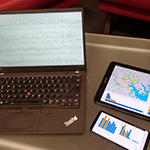
@inproceedings{Horak2019,
author = {Tom Horak and Andreas Mathisen and Clemens N. Klokmose and Raimund Dachselt and Niklas Elmqvist},
title = {Vistribute: Distributing Interactive Visualizations in Dynamic Multi-Device Setups},
booktitle = {Proceedings of the CHI Conference on Human Factors in Computing Systems},
year = {2019},
month = {5},
location = {Glasgow, Scotland, UK},
pages = {616:--616:13},
doi = {10.1145/3290605.3300846},
publisher = {ACM}
}List of additional material
, Video
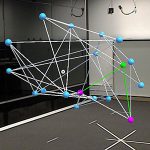
@article{fixme,
author = {Wolfgang B\"{u}schel and Stefan Vogt and Raimund Dachselt},
title = {Augmented Reality Graph Visualizations: Investigation of Visual Styles in 3D Node-Link Diagrams},
journal = {IEEE Computer Graphics and Applications},
volume = {39},
number = {3},
year = {2019},
month = {2},
isbn = {0272-1716},
pages = {29--40},
numpages = {12},
doi = {10.1109/MCG.2019.2897927},
url = {https://doi.org/10.1109/MCG.2019.2897927},
publisher = {IEEE}
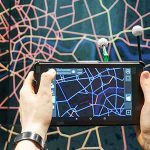
}
@inproceedings{fixme,
author = {Ricardo Langner and Raimund Dachselt},
title = {Towards Visual Data Exploration at Wall-Sized Displays by Combining Physical Navigation with Spatially-Aware Devices},
booktitle = {Poster Program of the 2018 IEEE VIS Conference},
year = {2018},
month = {10},
location = {Berlin, Germany},
numpages = {2}
}List of additional material
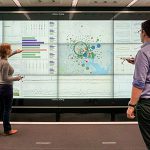
@article{fixme,
author = {Ricardo Langner and Ulrike Kister and Raimund Dachselt},
title = {Multiple Coordinated Views at Large Displays for Multiple Users: Empirical Findings on User Behavior, Movements, and Distances},
journal = {IEEE Transactions on Visualization and Computer Graphics},
volume = {25},
issue = {1},
year = {2019},
month = {1},
location = {Berlin, Germany},
pages = {608--618},
numpages = {11},
doi = {10.1109/TVCG.2018.2865235},
url = {https://doi.org/10.1109/TVCG.2018.2865235},
publisher = {IEEE},
keywords = {multiple coordinated views, wall-sized displays, mobile devices, distant interaction, physical navigation, user behavior, user movements, multi-user, collaborative data analysis}
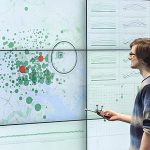
}
@article{langner2018combining,
author = {Ricardo Langner and Ulrike Kister and Marc Satkowski and Raimund Dachselt},
title = {Combining Interactive Large Displays and Smartphones to Enable Data Analysis from Varying Distances},
booktitle = {Proceedings of the AVI 2018 Workshop on Multimodal Interaction for Data Visualization},
series = {MultimodalVis '18},
year = {2018},
month = {5},
location = {Castiglione della Pescaia, Grosseto, Italy},
numpages = {4}
}List of additional material
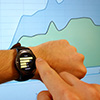
@inproceedings{Horak2018,
author = {Tom Horak and Sriram Karthik Badam and Niklas Elmqvist and Raimund Dachselt},
title = {When David Meets Goliath: Combining Smartwatches with a Large Vertical Display for Visual Data Exploration},
booktitle = {Proceedings of the CHI Conference on Human Factors in Computing Systems},
year = {2018},
month = {4},
location = {Montreal, QC, Canada},
pages = {19:1--19:13},
doi = {10.1145/3173574.3173593},
url = {https://doi.org/10.1145/3173574.3173593},
publisher = {ACM}
}List of additional material
, Video
Student Thesis
Investigation of Edge Visualization for Spatial 3D Node Link Diagrams
October 9th, 2017 until April 8th, 2018
Supervision: Wolfgang Büschel, Raimund Dachselt
Supporting Collaborative Web Search and Result Exploration in a Shared Display Environment
June 19th, 2020 until November 20th, 2020
Supervision: Anke Lehmann, Annett Mitschick, Raimund Dachselt
Support and Implications of Group Awareness for Collaborative Web Search
December 6th, 2019 until May 8th, 2020
Supervision: Anke Lehmann, Ricardo Langner, Annett Mitschick, Raimund Dachselt
User Behavior during Collaboration at two Large Displays
February 11th, 2019 until July 15th, 2019
Supervision: Anke Lehmann, Raimund Dachselt
Analyzing Collaborative Interaction Techniques for Brainstorming at Interactive Wall Displays
January 7th, 2019 until June 9th, 2019
Supervision: Anke Lehmann, Raimund Dachselt
Smartphone support for the interaction with result visualizations in Augmented Reality
June 15th, 2018 until November 16th, 2018
Supervision: Wolfgang Büschel, Annett Mitschick, Raimund Dachselt
Support for In-situ Analysis of Interaction Data in Augmented Reality Environments
October 12th, 2018 until March 15th, 2019
Supervision: Wolfgang Büschel, Anke Lehmann, Raimund Dachselt
Linked Visualizations for Data Analysis in Mixed Reality Multi Display Environments
May 18th, 2018 until November 8th, 2018
Supervision: Wolfgang Büschel, Raimund Dachselt
Investigation of Off-screen Visualization Techniques for Spatial Visualization in Augmented Reality
January 8th, 2018 until June 10th, 2018
Supervision: Wolfgang Büschel, Raimund Dachselt
Sorting and grouping ideas and documents on physical and digital surfaces - a literature review.
April 12th, 2021 until June 28th, 2021
Supervision: Anke Lehmann, Raimund Dachselt
Schematic Visualization of Movement Patterns in Human-computer Interaction
June 5th, 2020 until October 22nd, 2020
Supervision: Raimund Dachselt, Anke Lehmann, Wolfgang Büschel
Concept and Development of a Logging Tool to Track Users and Activities in Multi-Display Environments
December 6th, 2019 until February 21st, 2020
Supervision: Anke Lehmann, Raimund Dachselt
Responsive Information Visualization in Augmented Reality
October 1st, 2019 until December 17th, 2019
Supervision: Wolfgang Büschel, Annett Mitschick, Raimund Dachselt
Extended Visualization Concepts to Supplement an Augmented Reality Analysis Framework
July 19th, 2019 until October 4th, 2019
Supervision: Wolfgang Büschel, Raimund Dachselt
Improving an Analysis and Visualization Framework by Centralizing Data Management and Preprocessing
July 5th, 2019 until September 20th, 2019
Supervision: Wolfgang Büschel, Anke Lehmann, Raimund Dachselt
Requirements Analysis of Collaborative Brainstorming Applications on Interactive Wall Displays
February 13th, 2019 until April 30th, 2019
Supervision: Anke Lehmann, Raimund Dachselt
Supporting the Exploration of Multivariate Data in Augmented Reality with Mobile Devices
January 11th, 2019 until March 29th, 2019
Supervision: Wolfgang Büschel, Raimund Dachselt
Concepts for the Support of Collaborative Data Analysis in Augmented Reality
January 11th, 2019 until March 29th, 2019
Supervision: Wolfgang Büschel, Raimund Dachselt
Spatially-aware Visualization of Query Results in Augmented Reality
October 1st, 2018 until December 17th, 2018
Supervision: Wolfgang Büschel, Annett Mitschick, Raimund Dachselt
Investigation of Links between Visualizations in Augmented Reality
July 20th, 2018 until October 5th, 2018
Supervision: Wolfgang Büschel, Raimund Dachselt